

[Information reprint] Four levels of plant health
What makes a healthy plant? How to evaluate the health level of crops? John Kempf, founder of Advancing Eco Agriculture and a pioneer in plant nutrition, designed a pyramid model to describe the health of plants in the face of pests, diseases, and adverse growing environments.
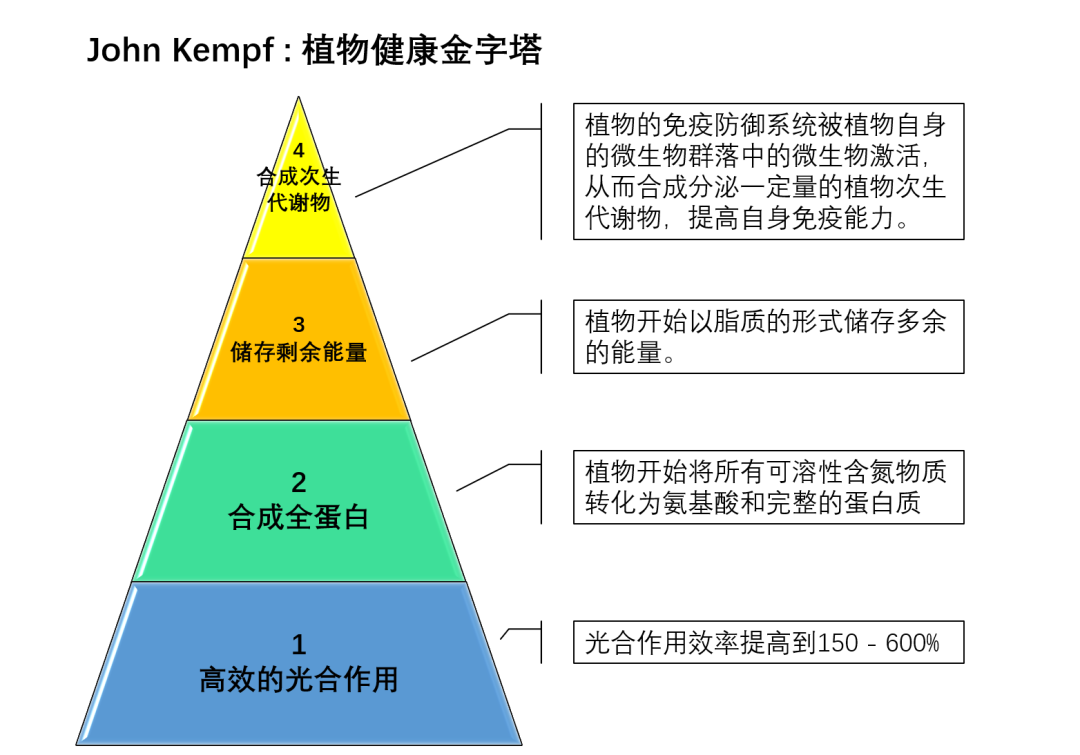
Health levels 1 and 2 relate to the nutritional integrity of the plant. Health Levels 1 and 2 are generally not difficult to achieve for most crops and soil conditions, especially if nutritional supplements can be sprayed on the foliage. Most crops will reach these levels after three to four months of cultivation.
Levels 3 and 4 of the health scale are not as easy to achieve as the first two levels. In order to reach the third stage, there must be a healthy and vibrant soil environment that can meet the nutritional needs of the plants. Without a good soil microbiome, plants will never have the excess energy to produce high lipids, and there will be no excess energy to store.
Optimal nutritional conditions improve plant viability
With the continuous adaptation to the ecological agricultural farming environment, the health and productivity levels of soil and crops will continue to improve. During this process, the production of plant lipids increases. These plant lipids have important physiological functions. Some form the cuticle (wax) on the plant surface and cover most of the plant body. Some are important substances that constitute biological membranes (glycolipids and phospholipids). Some are important for storing energy (fats and oils). Others serve as regulatory substances or even as plant hormones that play a very important role in plant growth and development.
Along with the increase in lipids, plants' resistance and immunity to soil and airborne pathogens and insect diseases also increase. At the same time, crop yields, fruit quality have increased and they taste better. In the lower two levels of the aforementioned pyramid, changes are mainly related to plant biochemistry, while the changes occurring in the third and fourth levels are mainly biological in nature and can only be achieved through effective regenerative ecological agriculture. By creating a recyclable ecological agricultural environment, the health of crops can be maintained.
Plant immune systems require good mineral nutrition to sustain
The metabolic activities of plants require the catalysis of various enzymes to complete. To be able to continuously produce highly complex metabolites and achieve optimal levels of health and immunity, plants require an efficient enzyme system. Thousands of enzymes required for metabolic processes require mineral cofactors to function. Without these mineral cofactors, enzymatic reaction pathways collapse, and plants accumulate large amounts of soluble compounds in the sap without efficient catalytic use. As a result, their health and immunity levels begin to decline, opening the door to infection by various diseases. A functional enzyme system requires up to 58 cofactors based on different cations, including some trace elements. These accessory mineral factors are essential for the proper functioning of plant, animal and human immune systems.
The best source of nutrients for plants is microbial metabolites
To achieve optimal levels of health, most of the nutrients required by plants should be absorbed in the form of microbial metabolites. In this case, soil microbial communities feed on plant root exudates and provide the plant with an efficient "digestive system" by breaking down organic residues in the soil. During this digestion process, minerals are extracted from the mineral matrix of the soil and released in a bioavailable form that plants can efficiently absorb and utilize. Only when plants have an efficient digestive system maintained by microorganisms can plants achieve a higher level of health. If plants derived most of their nutrient uptake from simple ionic forms in the soil solution, they would never have the energy they need to achieve optimal health and immune levels.
Healthy plants resist disease and pests
Everyone knows that animals and humans have an immune system to protect themselves from pathogens. This is our innate natural immune defense system. In order for our immune system to work properly and perform its functions, it needs to be supported by a high-quality diet. If certain nutrients are deficient, or not available in the proper form, the normal function of the immune system can be compromised. A balanced and complete diet is the essential foundation for maintaining an effective immune system. The same is true for plants. Only plants with good nutritional conditions can have effective defense mechanisms that enable them to resist diseases and pests.
Quality determines output
Agroecology and improving crop nutrition focus on improving plant health and quality rather than increasing yields. When we balance the nutrition of our crops, their quality, energy and immunity are greatly improved, with the result being higher yields, better product storage, better flavor and less reliance on pesticide treatments. In this way, improving crop product quality and increasing yields become mutually reinforcing. This method of "feeding" the plant is fundamentally different from usual practice and automatically results in a significant increase in yield, which in many crop types can range from 10 to 30 percent or even more.
Healthy plants create healthy soil
It is often said that healthy soil breeds healthy plants, but the reverse is also true. At certain stages of plant development, healthy plants at high productivity levels can bring up to 70% of photosynthetic products to the soil through root exudates. These carbohydrate-rich secretions serve as nutrients and fuel for soil microbial communities, contributing to the rapid formation of healthy soil. This process, known as "carbon induction," is the fastest and most efficient way to stabilize the enrichment of organic matter in the soil.
(Original text from: Lallemand Plant Protection Technology)