
Scientific cultivation, quality and efficiency improvement: Demonstration of application results of kiwifruit biodynamic cultivation plan
1. Background and needs
At present, my country's kiwifruit planting industry has a wide variety of varieties and fast update and iteration speed. Growers often face the challenge of variety selection and adjustment. As the consumer market's requirements for fruit quality continue to improve, especially the higher standards set by high-end sales channels for fruit appearance, dry matter content, storage stability, etc., many fruits are difficult to achieve high quality and price due to substandard quality, which affects the improvement of industrial efficiency.
In this context, if a company plans to build its own brand and enter the high-end market, it must systematically improve the quality of its fruits and achieve standardized management throughout the entire process from planting to post-harvest processing. At the same time, for companies that have independent variety rights and hope to carry out brand licensing and large-scale cooperation, a mature, replicable, and highly stable standardized cultivation technology system has become a key element to support brand promotion and expand demonstration influence. 2. Design and implementation of technical solutions
2. Design and implementation of technical solutions
In 2024, we cooperated with a planting company in Sichuan and carried out a systematic quality improvement test demonstration at its base, focusing on the three aspects of soil biological vitality improvement, nutrient targeted supplementation and precise fertilizer and drug management, and built a standardized full-process biological vitality cultivation system that is replicable and cost-controllable.
The main technical measures include:
• Improved soil biological vitality : Use microbial inoculant products such as Tubeikang and Dibeijian to enhance soil activity and improve physical and chemical properties. ;
• Qualitative Nutritional regulation : According to the characteristics of fertilizer requirements during the phenological period, use products such as Futawang, Quanzhou Micro Calcium Magnesium Boron, Protective Potassium, and Colored Honeydew to improve fruit sugar content, dry matter, and storability. ;
• Digital agricultural monitoring : Deploy soil sensors to monitor water and fertilizer dynamics in real time and assist in fertilization and irrigation decisions.
The test has a total of 3 demonstration plans and 2 conventional controls, each with an area of 5 acres. The specific plans are as follows:
Table 1: Summary of the 2024 Demonstration Zone Technical Plan
|
demonstration plan |
period |
roots Use fertilizer |
Leaf surface Use fertilizer |
execution date |
|
Option 1 |
Small fruit expansion period |
Futa is prosperous |
— |
May 19 |
|
Middle stage of fruit expansion |
Futa is prosperous |
— |
June 7 |
|
|
Option 2 |
small fruit period |
Futawang + Quanbo Micro Calcium Magnesium Boron |
— |
May 19 |
|
Middle stage of fruit expansion |
Futawang + Quanbo Micro Calcium Magnesium Boron |
— |
June 7 |
|
|
Middle stage of fruit expansion |
— |
Protective food |
July 30 |
|
|
Late stage of fruit expansion |
Light autumn fragrance |
Protective Potassium + Colored Honey |
September 12 |
|
|
mature stage |
Light autumn fragrance |
Protective Potassium + Colored Honeydew |
September 20 |
|
|
Option 3 |
Before the flowers |
— |
Bonifida + Meco Green |
April 19 |
|
small fruit period |
Futawang + Quanbo Micro Calcium Magnesium Boron |
— |
May 19 |
|
|
Middle stage of fruit expansion |
Futawang + Quanbo Micro Calcium Magnesium Boron + Aiwangshi slow-release fertilizer |
— |
June 7 |
|
|
Middle stage of fruit expansion |
— |
Protective food |
July 30 |
|
|
Late stage of fruit expansion |
Light Autumn Incense + Protective Potassium |
Protective Potassium + Colored Honey |
September 12 |
|
|
mature stage |
Light Autumn Incense + Protective Potassium |
Protective Potassium + Colored Honeydew |
September 20 |
3. Implementation results and data analysis
On October 18, 2024, we sampled and tested the fruits in the demonstration area and the control area. Data show that the fruits in the demonstration area are significantly better than the control in terms of dry matter, sugar content, VC content, calcium content and storage stability.
surface 2 Biological Vitality Plan and Control Area Fruit quality project Raw detection data
|
Test items |
unit |
Bio Vitality Program 1 |
Bio Vitality Program 2 |
Bio Vitality Program 3 |
control area 1 |
control area 2 |
|
Storage stability |
sky |
9 |
9 |
9 |
9 |
7 |
|
total soluble sugar (fruit) |
% |
3.75 |
4.00 |
4.99 |
3.53 |
3.87 |
|
total soluble sugar (ripe fruit) |
% |
9.52 |
8.67 |
11.66 |
9.58 |
9.58 |
|
Dry matter content |
% |
14.26 |
16.67 |
15.88 |
13.77 |
14.94 |
|
total acid |
g/ kg |
13.26 |
14.45 |
14.24 |
14.85 |
12.81 |
|
Calcium content |
mg/ kg |
265.56 |
353.20 |
343.73 |
250.43 |
288.90 |
|
Potassium content |
% |
0.37 |
0.37 |
0.41 |
0.34 |
0.41 |
|
VC content |
mg/100g |
177.21 |
201.71 |
234.22 |
205.87 |
284.86 |
surface 3 Comparison and improvement of average fruit quality data between demonstration area and control area
|
Test items |
unit |
Demonstration area average |
Average control area |
Improvement |
|
Storage stability |
sky |
9.00 |
8.00 |
+12.50% |
|
total soluble sugar (fruit) |
% |
4.25 |
3.70 |
+14.86% |
|
total soluble sugar (ripe fruit) |
% |
9.95 |
9.58 |
+3.86% |
|
Dry matter content |
% |
15.60 |
14.36 |
+8.64% |
|
total acid |
g/ kg |
13.98 |
13.83 |
+1.08% |
|
Calcium content |
mg/ kg |
320.83 |
269.67 |
+18.97% |
|
Potassium content |
% |
0.38 |
0.38 |
/ |
|
VC content |
mg/100g |
204.38 |
195.37 |
+4.61% |
Based on the average effects of the three demonstration areas, this biological vitality cultivation plan is superior to conventional control management in most key quality indicators. The core advantage lies in the significant improvement in storage stability, sugar content, dry matter and calcium content. for extended shelf life , Improve fruit flavor , promote Fruit weight and firmness Very important. This shows that the biological vitality cultivation method plays a very good role in promoting the improvement of fruit quality.
4. Reflection of comprehensive benefits
1. Steady increase in output
In the new variety park of the base, through the implementation of the full biological vitality cultivation plan, the yield per mu has achieved three consecutive years of growth.:
surface 4 : Changes in output of varieties at this base in recent years
|
years |
Yield (jin/mu) |
Level of technical cooperation |
|
2022 |
≈4000 |
Not cooperating |
|
2023 |
≈5000 |
Partial use of our products |
|
2024 |
≈6000 |
Full biological vitality cultivation plan |

control: There are few fruits and the fruits are small.
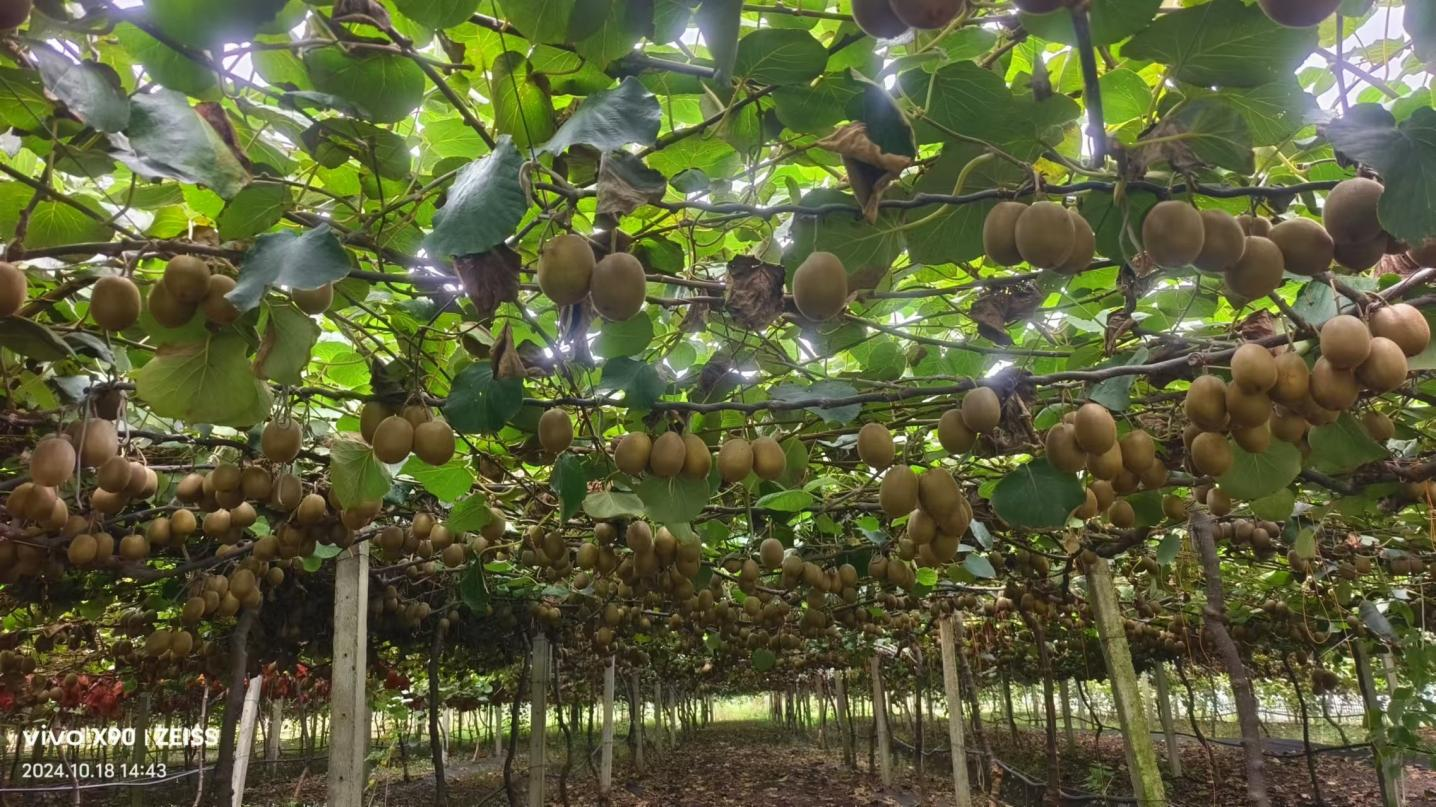
Demonstration Garden: There are many fruits, the fruits are big and the fruit shape is round.
2. Cost savings and fertilizer reduction
Through soil improvement and biological vitality improvement, the amount of chemical fertilizers applied per mu in the 2025 plan will be reduced by 15 kg, a decrease of about 15%, while maintaining both quality and yield improvements.
3. Initial results have been achieved in the prevention and control of ulcer disease
The bioactive cultivation method has shown an inhibitory effect on kiwi canker disease and helps achieve sustainable cultivation.

4. Significant economic benefits
This new variety is purchased at a guaranteed price, with a unit price of 3 yuan/jin. The output value per mu in 2024 will be approximately 18,000 yuan, with a net income of over 10,000 yuan, and a superior input-output ratio.

Appearance quality comparison
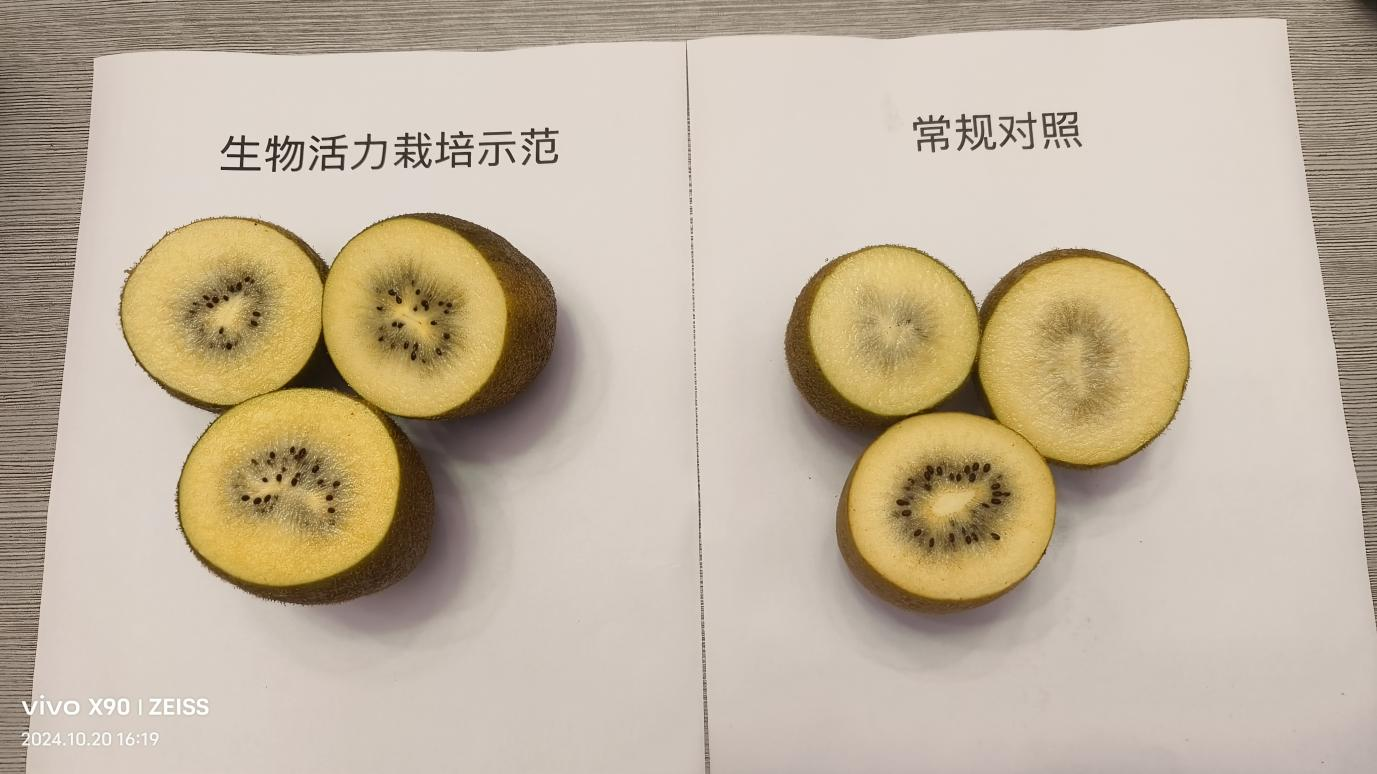
Intrinsic quality comparison
5. Promotion value
Through systematic tests in 2024, this project has verified the comprehensive effect of biological vitality cultivation technology in improving kiwi fruit quality, soil improvement, disease prevention and control, and yield increase. In 2025, this technical solution has been incorporated into the company's standardized production procedures and will be fully promoted and applied in its hundreds of acres of demonstration base.
This solution has strong replicability and adaptability. It is not only suitable for large-scale planting bases, but can also provide reliable technical reference for small and medium-sized growers, helping the kiwifruit industry achieve high-quality, efficient, green and sustainable development.